What I Brought Home from the Cavalry

It's been a while since I've written here. Today is Veterans Day, and I want to talk about something that connects my time in the cavalry to the work we do at Aboriginal Armadillo: trusting people to make a decision when you can't give them instructions for everything they're about to encounter.
There's a moment from Kandahar that helps explain what I mean.
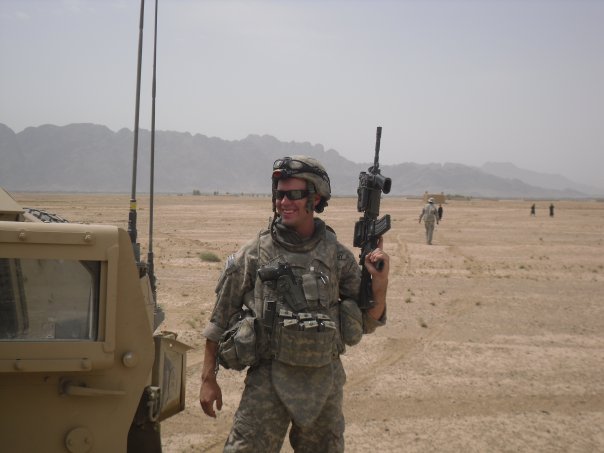
Me during my service. This photo is separate from the story below.
Five minutes up the road
We were police mentors in Kandahar. One of the police stations was under attack from the Taliban, and we went out to help. I was a medic.
As I was getting out of the truck, someone told me there were two wounded men: one grazed in the shoulder, and one with a bullet in his head.
They were in the bed of a pickup. I looked at the man with the head wound and thought, "Well, I can't fix dead."
But I checked.
He was breathing, which on its own hadn't convinced me. Then I felt a radial pulse, a pulse at his wrist. I hadn't expected that. He was in much better shape than I'd expected from looking at the wound.
The other man seemed in good enough shape to make the trip. There was a Canadian base with a surgeon about five minutes up the road. I told them to drive like hell. They didn't have much time.
They went.
Later, I went to the troop medical clinic and asked about him. He'd survived. They were surprised too.
They also gave me a light tongue-lashing for not establishing an IV line before sending him. It had taken them a few minutes to get one in.
I took the criticism. My judgment had been that getting him to a surgeon mattered more than spending those minutes trying to establish the line myself. I still think that was the right call. I can't know what would have happened if I'd done it differently, and his survival doesn't settle every question about my decision.
What I had in front of me was a wounded man, a truck, and surgical care five minutes away. I had to decide what to do with those facts.
The part of the cavalry ethos that matters to me
That story isn't an argument for ignoring procedure. Training is what gave me a basis for making the decision at all. And making a call didn't exempt me from answering for it afterward.
It's an example of the kind of judgment I associate with my time in the cavalry. You move toward a situation you don't fully understand. You look at what's actually there, including the thing that contradicts your first impression. Then you act with the objective in mind.
The audacity in that ethos has to come with competence. Otherwise you're just making your confidence somebody else's problem.
Initiative also requires trust from the people around you. If every unexpected development has to travel back up a chain for a new set of instructions, the person standing in front of the problem can't do much with what they've learned. You need people who understand the objective well enough to make useful decisions as the situation changes.
Those decisions still belong to a team. The people at the Canadian base did the work I couldn't do. Getting that man to them was the point.
Why we hire for judgment
Building software isn't combat. The stakes of that afternoon don't transfer to a client project, and I don't need to pretend they do to explain what stayed with me.
At Aboriginal Armadillo, our staff currently consists entirely of seasoned industry veterans. By that I mean people with deep professional experience, not a claim that everyone served in the military (though about 70% have).
If you're looking for cheap bodies, we're probably a bad fit. If you have a difficult problem and need people who can work toward your company's goals without being given explicit directions for every step, we're a much better match.
That distinction matters because specifying every step is work. When you hire expertise but still have to supply every technical decision, a large part of the problem remains on your desk. I want clients to be able to explain what they're trying to accomplish and rely on us to exercise judgment about how to get there.
That requires understanding the business objective well enough to question a requested implementation. It also requires recognizing when a decision belongs to the client. Independence doesn't mean quietly making commitments on somebody else's behalf.
Consider a hypothetical project where a client asks for a new application to remove an operational bottleneck. An experienced engineer should investigate whether a new application would actually remove it. Perhaps a smaller change to an existing system would do the job. Perhaps the missing piece is a decision nobody has been authorized to make. Discovering that should change the proposed work, even if building the original request would be easier to sell.
That's the judgment we're asking clients to hire us for.
Putting it into words
We've been working on an internal mission statement. It isn't finished or published, but the cavalry influence is explicit in the thinking behind it.
We're trying to describe a company where a small, experienced team can take on uncertain work, where people have room to act on what they know, and where responsibility extends to whether the work actually helps the client. Some of that describes the team we have today. The statement is also a standard we have to keep earning.
I want the software we build to leave clients able to do things they couldn't do before, without making them direct every move we make along the way.
On this Veterans Day, that's the connection I wanted to put into words after a long stretch away from the blog. My time in the cavalry still informs what I expect of myself and the kind of company I want us to build.
If you're leading experienced people, give them a clear objective and be explicit about which decisions they can make. Then leave them enough room to use the judgment you hired them for.